I know the scene because I hear it more and more often: you described your business to Lovable, Manus or Claude Code, iterated for a while, and in one afternoon you had a website that a year ago would have cost you weeks and a fair amount of money. You showed it around, people liked it, you shipped it. A few weeks later you search for your brand on Google and you're not there. You ask ChatGPT about businesses like yours and it recommends your competitors, whose websites are frankly worse.
The last one that reached me was a small coaching consultancy. They had built their site with Manus, it looked good, and they had been running a marketing campaign for almost two months with the budget ticking. You searched their name on Google and nothing came up. They were paying to send people to a website that, as far as Google was concerned, did not exist.
The first reaction is usually to assume Google is just slow, and there is some truth to that. But when the silence drags on, the cause is almost always something else: your site is live, but bots can't read it properly. And without knowing how to code, there's no way to tell one case from the other, because the site looks perfect in your browser.
Google doesn't see your website: it sees its skeleton
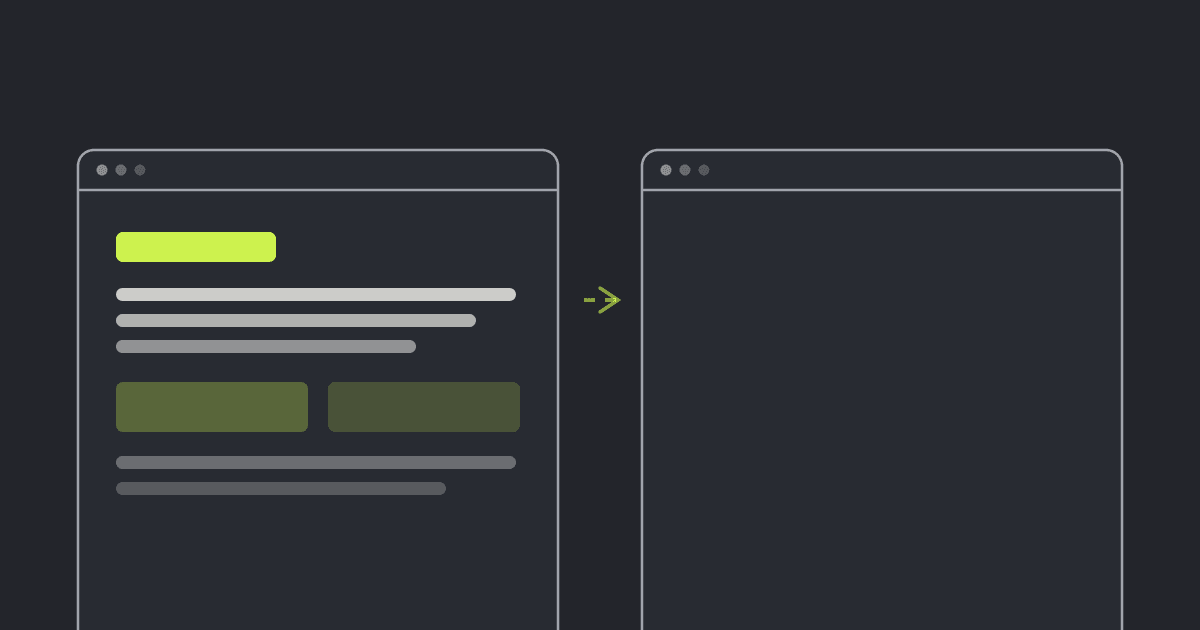
When someone visits your website, two things happen: the server sends a document, and the browser finishes building it by running code. Some websites arrive from the server already complete, with their text and titles in place. Others arrive nearly empty, a skeleton, and it's the visitor's browser that fills them in afterwards. If the acronyms ring a bell, this is the difference between SSR and CSR.
To a person that difference is invisible: their browser does the work and the site appears. To a bot it isn't. Google's bot knocks on your door, looks at what the server hands over, and makes decisions based on that. If it gets the skeleton there are scenarios where it runs your code and eventually sees the content, but that path is slower and comes with no guarantees. Plenty of other bots don't even try: they read what's there and leave.
And it affects you in particular because several of the most popular vibe coding tools produce the second kind of website by default. That's a reasonable call on their part: what we ask of them is to see something working in thirty seconds, and client-side rendering is the short road there. What I find less reasonable is that they don't warn you when you publish. You hit a button that says "Publish", the site goes live, everything green, and nobody mentions that you have just put something on the internet that Googlebot may never manage to read. The result is a website that's beautiful to humans and, to certain bots, a blank page.
How to check whether bots can read your site
You don't have to take my word for it, or learn to read source code. I built a free tool that runs exactly this check: the SSR/SEO auditor. Paste your URL and you get a report in a couple of minutes.
Of everything it returns, look first at the two screenshots. On the right, your site with JavaScript: what a person sees. On the left, without it: very close to what a bot receives before deciding whether to run your code at all.
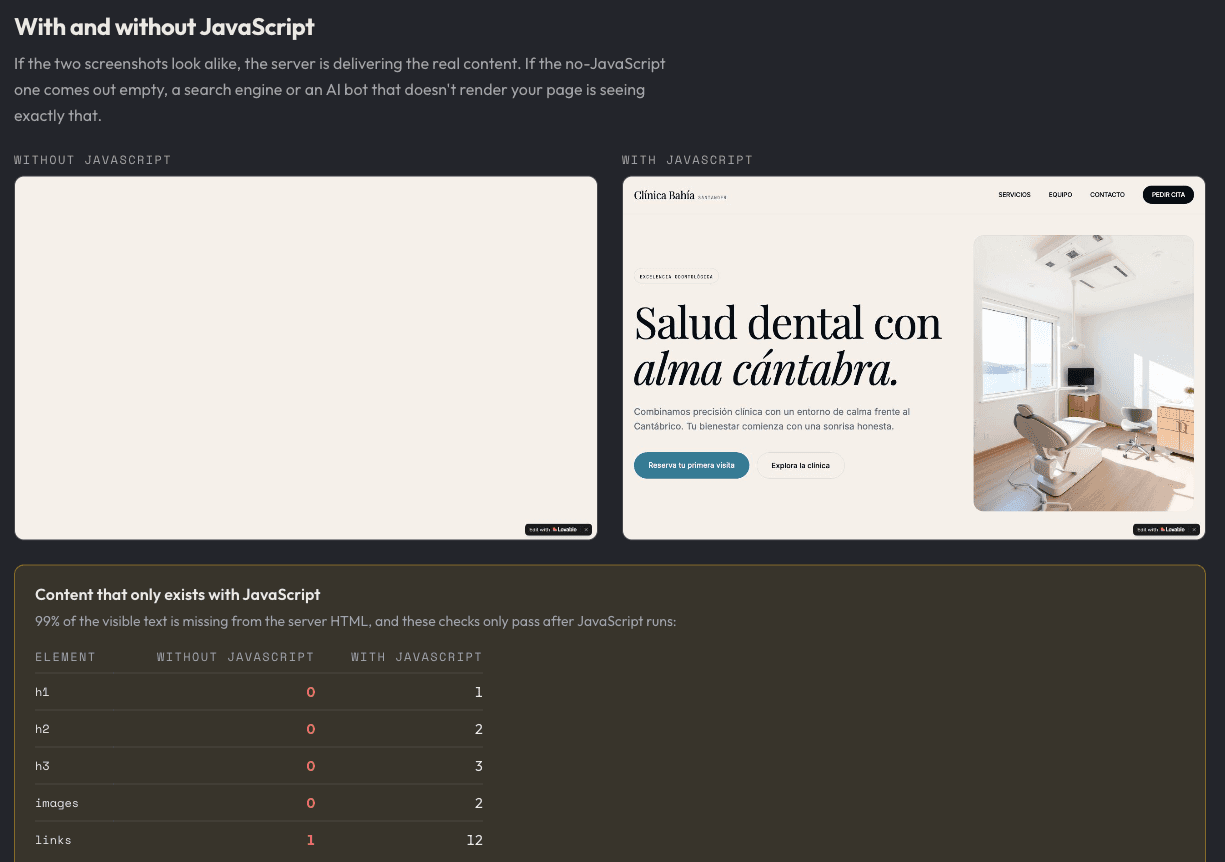
That's a real website built with Lovable, audited while I was writing this. The screenshot without JavaScript doesn't come out thin: it comes out empty. And the report quantifies it underneath, which is what turns a suspicion into a diagnosis: 99% of the visible text is missing from the HTML the server delivers, and where there should be one h1, two h2s and three h3s, there are zeros.
If your two screenshots look alike, breathe: your content arrives from the server and you've got the hard part right. If the left one comes out blank or missing almost everything, you've just found the reason you're not showing up. Google hasn't penalised you, and your business hasn't stopped being interesting. You're simply handing over the skeleton.
LLMs read your site the same way Google does
There's a second question I get asked more and more: "how do I get ChatGPT to recommend my business?". The honest answer is that nobody can guarantee you a spot in an AI model's answers, and you should distrust anyone selling you otherwise.
But there is one thing that's known with certainty: how to guarantee the opposite, that you never show up.
Models like ChatGPT, Gemini or Claude know about the web because crawlers (GPTBot, ClaudeBot and friends) roam it, and they work just like Google's: they request your page and read what the server hands over. A website bots can't read never enters any index or any training corpus, and no amount of marketing afterwards fixes that.
That's why the auditor's report also checks whether your site lets AI bots in or is blocking them. It happens more than you'd think: some templates and configurations ban them by default, and nobody checks until someone goes looking.
How to read your report without being technical
The report gives you a score and a list of checks. The ones that matter:
- The rendering verdict sums up everything above: whether your content arrives from the server, arrives halfway, or doesn't arrive. It's the one that counts.
- Title and description are your storefront in search results: the blue text and the two grey lines. AI-generated sites tend to ship generic or plain empty ones.
- The sitemap is the map of your website you hand to bots so they don't have to guess which pages exist.
- AI bots: whether your site lets them in or blocks them.
Every warning comes with a plain-language explanation inside the report itself. Red on rendering is the serious problem; the rest are usually an afternoon's work.
The three fixes that solve most cases
1. Titles and descriptions. This is the most rewarding fix and your own AI tool can do it. Go back to Lovable, Claude Code or whatever you use and ask for it like this:
Review the title and the meta description of every page on my website.
The title should describe what I offer and for whom, in under 60
characters. The description should summarise the page in under 155
characters and invite the click. Write them in the site's language and
make them different on every page.2. Sitemap and Search Console. Ask your tool to generate a sitemap if you don't have one, and sign up for Google Search Console: it's free, and it's the errand nobody mentions to someone shipping their first site. There you verify you own the site, submit your sitemap, and see which of your pages Google is actually keeping.
3. The hard case: your site comes out blank without JavaScript. This one doesn't always have an easy fix. Some platforms let you switch on server rendering or prerendering with a configuration change, and it's worth asking your tool or searching their docs for it. Other times the site is built in a way that doesn't allow it, and the real options are migrating to a different foundation or bringing in someone technical. If that's your case, at least you now know exactly what the problem is and what to ask for, which is the difference between hiring blind and hiring with criteria.
Start by knowing where you stand
You can't fix what you can't see, and until today you couldn't see your website the way bots see it. Now you can: run your site through the auditor, look at the two screenshots and read the verdict. It takes two minutes.
And if the report comes back red and the fix is over your head, that's what I do for a living: technical consulting explains how I work, and from there you can book a call and we'll look at your specific case together.
Thanks for reading this post
Send feedbackIf you found it useful, share it: it helps reach more people and keeps me motivated to write.
Share this post on: